
The inputs are numerous. On closer examination, however, conformity assessment bodies (CABs) face common issues in their day-to-day operations. Opportunities depend primarily on the type of laboratory and the expectations of its management.
A few definitions to establish a common language when discussing risks and opportunities.
8.5 - Risks and Opportunities
8.5.1 The laboratory shall consider the risks and opportunities associated with laboratory activities in order to:
a) give assurance that the management system can achieve its intended results;
b) enhance opportunities to achieve the purpose and objectives of the laboratory;
c) prevent or reduce undesired impacts and potential failures in laboratory activities;
and d) achieve improvement.
8.5.2 The laboratory shall plan:
a) actions to address risks and opportunities;
b) how to:
– integrate and implement these actions into its management system;
– evaluate the effectiveness of these actions.
8.5.3 Actions taken to address risks and opportunities shall be proportional to the potential impact on the validity of laboratory results.

Risk has traditionally been associated with danger. A newer approach, promoted by ISO 9001, considers risk as a driver for progress: by anticipating risks in order to control or accept them, the CAB can pursue specific improvements.
Risk is often viewed only negatively. Risk-based thinking can also help identify opportunities, which may be seen as the positive side of risk.
Before risks and opportunities associated with laboratory activities can be addressed, they must first be identified.
Several methods are available to identify an organization’s risks and opportunities. Risk-analysis standards do not impose a particular method; users choose according to their objectives and their short- or long-term strategy.
What does the standard require? Identification of risks and opportunities.
For risks: apply the 5M method to your equipment, examining everything associated with the equipment and its related test methods.
For opportunities: these depend largely on the type of CAB—an independent or an in-house laboratory.
Independent laboratories already gain insight into opportunities through satisfaction surveys and sales visits: expanding market share, reaching new customers, and implementing new test methods.
An in-house laboratory generally serves only its company. External opportunities are therefore limited unless it opens its services to outside customers. But could the resulting additional workload jeopardize its internal services? Are its procedures suitable for selling external testing services? Other opportunities include equipment replacement, bringing outsourced work back in-house, or developing new services in response to internal customers’ needs.
Where the laboratory is itself the entire CAB (independent laboratory), it can regard supporting functions as internal service providers. The task is to assess and document, through risk analysis, whether interactions with IT, HR, purchasing and other departments meet the standard’s requirements. Already-accredited laboratories normally meet most of these requirements.
Where the laboratory is a separate unit within a larger company (in-house laboratory), it should consider its supporting functions as external providers. It should evaluate them as it would other external suppliers and perform a customer–supplier relationship risk assessment to establish that the arrangements meet the standard’s requirements.
Example illustrating the level of analysis: The IT department documents company data backup arrangements in a procedure. The laboratory is not on the distribution list and the quality department to which it reports does not approve the procedure. The laboratory must therefore obtain and review this document as it would any other external document (standard, specification, etc.) to verify that the IT arrangements comply with ISO/IEC 17025:2017.
When that procedure is revised, the analysis must be repeated; the laboratory must therefore be notified of changes.
Regardless of laboratory type, identify all supporting processes and services with which you have a customer–supplier or supplier–customer relationship.
The note also indicates that the CAB may extend its risk and opportunity assessment beyond testing activities, depending on its policies and strategic priorities.
As discussed earlier, PEST analysis examines the business and external environment in which the organization operates. PEST factors cannot be controlled by the CAB because they are external; the organization must adapt to them.
SWOT stands for Strengths, Weaknesses, Opportunities, and Threats.
A SWOT analysis is usually presented as a two-by-two matrix:
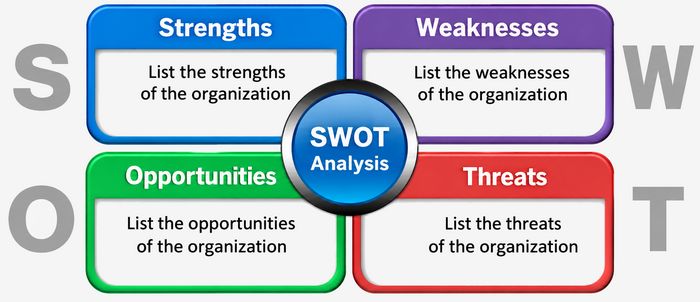
Unlike PEST factors, SWOT factors may be influenced by the organization: a threat may become an opportunity.
Strengths are internal to the organization and should be assessed as they exist today, without taking past or future conditions into account.
They include all capabilities and resources that the CAB—and potentially its partners and stakeholders actively participating in development—can use to achieve the desired outcome of a project, initiative or proposal.
– Local presence.
– Economic and financial resources.
– Fixed assets, infrastructure and equipment.
– Cost and competitiveness advantages.
– Skills, experience and knowledge, both theoretical and practical (know-how).
– Qualifications, accreditation and certification.
– Allies, contacts and partnerships.
– Leadership and initiative.
– Geographic advantages.
– Comparative advantages over competitors in systems, processes, operational efficiency, flexibility, quality standards and other areas.
– Activities the team or organization performs well.
– Other outstanding technical, scientific, managerial or leadership capabilities the organization can use.
Like strengths, weaknesses are internal factors relating to the organization or partnership implementing the project or initiative.
– Existing gaps in the CAB’s capabilities or resources.
– Weaknesses expected to arise in the future, such as the departure of key personnel or business interruption.
– Known vulnerabilities: things the organization does not do well.
Every organization has vulnerabilities. The purpose is to recognize them during planning.
– Areas in which a need for improvement has been identified by management, an audit, an external assessment, etc.
Opportunities are external factors in the operating environment in which a project or decision will be implemented.
– Favorable events or trends: political (government policies or shifts in stakeholder influence), economic (growth and new opportunities), social (behavioral or demographic changes), technological (innovation and new uses of technology), environmental (climate and favorable conditions), or legal (upcoming legislation and international treaties or agreements).
– Relationships or partnerships that can be leveraged.
– Other stakeholders who may support the initiative or project.
– Newly available information.
– Practices adopted by other organizations, competitor reviews and strategic monitoring that suggest opportunities.
– Potential funding sources.
– Potential efficiency gains from reallocating resources.
– Related initiatives, activities, projects or products.
– Benefits and favorable outcomes likely to result from actions identified through the SWOT analysis.
Like opportunities, threats are external factors in the operational context of the project or decision.
– Political, economic, social, technological, environmental or legal events and trends that could jeopardize progress.
– Risks and drawbacks associated with a given action, including risks to personnel or partners, reputation, finances, political considerations, costs and additional responsibilities.
A full risk assessment generally cannot be completed through SWOT alone, although basic risks may be identified. A more detailed assessment can be commissioned later.
– Time constraints, disappearing opportunities and unrealistic deadlines.
– Other stakeholders, harmful competition and conflicting interests.
– Opportunities that would be lost by taking a particular action.
– Other obstacles.
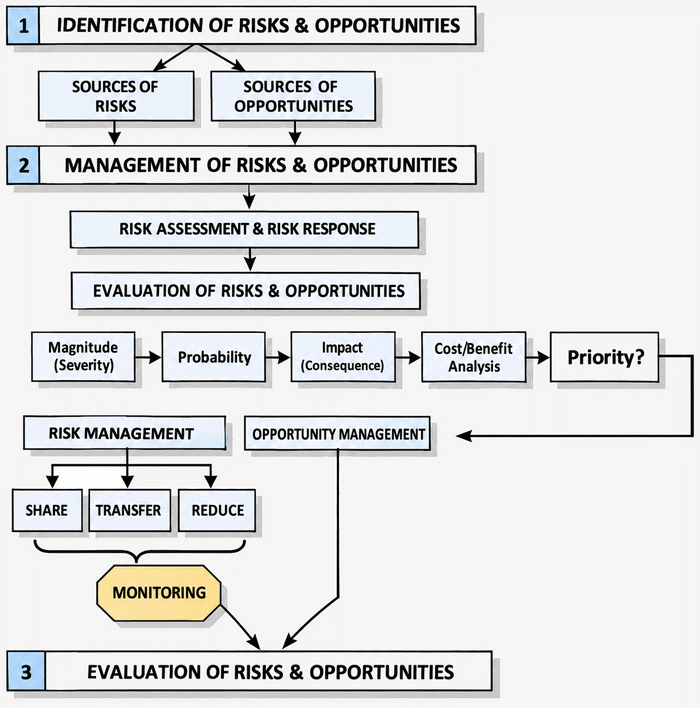
Turn weaknesses into strengths.
Turn threats into opportunities.
SWOT offers several advantages:
– It is easy to understand: a simple diagram without mathematics.
– It can be applied to individuals, teams, departments and entire organizations, up to corporate strategy.
– It can be performed at different levels of detail, from a quick screening to a comprehensive assessment.
– When used properly, it can be linked to corporate objectives and organizational strategy.
– It is highly visual and easy to communicate.
Despite its popularity and the advantages listed above, SWOT has several limitations:
– There is a temptation to rely on qualitative or subjective, anecdotal or hearsay information rather than quantitative evidence.
– Issues are easily described in generic rather than specific terms.
– Perceptions, personalities and preferences can introduce bias.
– Data collection, evaluation and decision-making can become confused.
– SWOT charts are often constructed incorrectly, especially when underlying principles are overlooked.
– Contextual factors are often ignored, wasting considerable time.
Example table showing selected identified risks (note that it lists all risks, not only residual risks).
| Requirements / Risks | Existing actions | Additional actions | Likelihood | Consequence | Risk level |
| 5.0 Structural Requirements | |||||
| Change in technical management | Appointment of a competent technical coordinator | Not required | Low | Low | Acceptable |
| Lack of management commitment to ISO/IEC 17025 | Current management is actively involved | Not required | Very low | High | Acceptable |
| Insufficient resources to maintain the system | Cross-trained personnel | Centralized QMS to optimize resources | High | High | Unacceptable |
| Scope inconsistent with the standards applied | Scope defined in the test list | Not required | Low | Moderate | Tolerable |
| Failure to meet accreditation requirements | Control of accreditation-related documentation | Not required | Low | High | Tolerable |
| Failure to maintain system integrity when changes occur | No | Transition plan and document review | Moderate | High | Tolerable |
| 6.2 Personnel | |||||
| Inadequate training of technical personnel | Training | Training monitoring | Very low | Very high | Acceptable |
| Significant changes in technical personnel (turnover) | Staff selection and training | Not required | Low | Very high | Tolerable |
| Failure to apply quality procedures | Training | Not required | Very low | High | Acceptable |
| Inadequate monitoring of competence | Informal monitoring | Define and formalize records (e.g., interlaboratory comparisons) | Low | Moderate | Tolerable |
| 6.4 Equipment | |||||
| Purchase or use of out-of-specification reagents | Purchasing specifications and checks before use. Verification of condition and expiration before each use; personnel training | Not required | Low | High | Tolerable |
| Failure to follow the calibration schedule | Tracking sheet displayed in the laboratory | Increase awareness | Low | High | Tolerable |
| Failure to perform or record equipment verification | Documented instructions and personnel training | Not required | Low | Moderate | Tolerable |
| Use of defective or noncompliant equipment | Identification of defective equipment or removal from the test area; personnel training | Not required | Low | Low | Acceptable |
| 7.1 Contract Review | |||||
| Incorrect identification of customer requirements | Review procedure and form; personnel training | Not required | Low | High | Tolerable |
| Exceeding laboratory capacity | Review procedure and records | Define acceptable test conditions | Low | High | Tolerable |
| 7.2 Selection, Verification and Validation of Methods | |||||
| Failure to confirm method performance as implemented by the laboratory | Personnel training, equipment verification and documented confirmation of method applicability | Not required | Low | High | Tolerable |
| Use of obsolete standards | Periodic review of external documents | Not required | Low | High | Tolerable |
| 7.4 Handling of Test Items | |||||
| Damage to samples due to improper handling | Personnel training | Not required | Low | High | Tolerable |
| Improper storage of samples before testing | Training procedure for handling test items | Add instructions for samples with special requirements | Low | Moderate | Tolerable |
| 7.5 Technical Records | |||||
| Erasures and illegible records | Personnel training | Not required | Low | High | Tolerable |
| Insufficient information to ensure traceability | Forms with appropriate record fields; personnel training | Not required | Very low | Very high | Acceptable |
| 7.7 Ensuring the Validity of Results | |||||
| Failure to monitor validity of testing | Test quality assurance procedure | Not required | Moderate | High | Tolerable |
| Failure to participate in interlaboratory comparisons | Schedule of interlaboratory comparison participation | Periodic review | Low | Low | Acceptable |
ISO 31000: Risk management — Guidelines
IEC 31010: Risk management — Risk assessment techniques
ISO Guide 73: Risk management — Vocabulary


