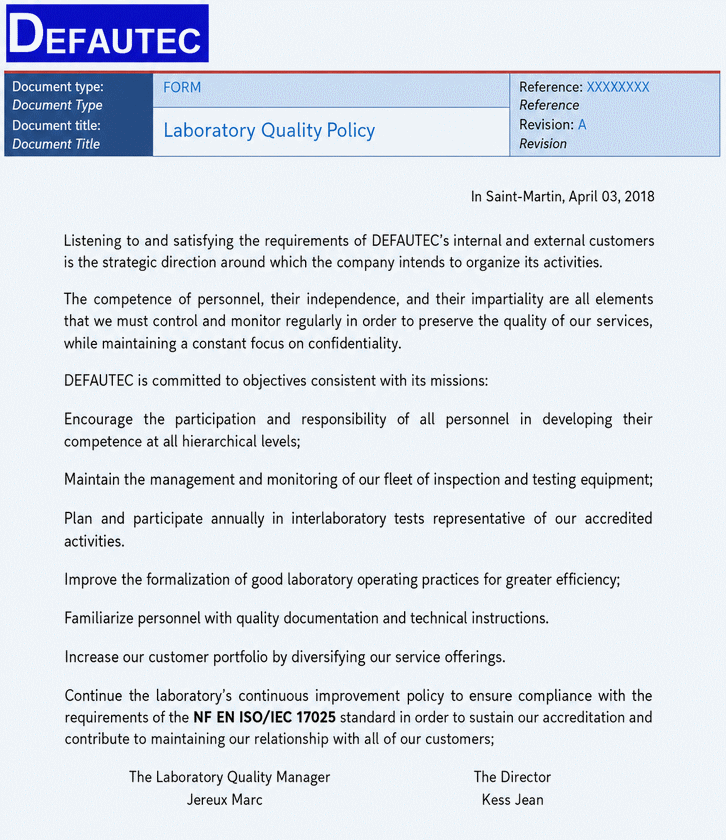
The policy must reflect the CAB’s strategy, address confidentiality and impartiality requirements, and be consistent with the organization’s activities.
The input data are varied and will be even broader and more numerous if the CAB has international representation, with diverse and potentially conflicting constraints.
8.2 - Management system documentation
8.2.1 Laboratory management shall define, document, and maintain a policy and objectives to meet the requirements of this International Standard and shall ensure that this policy and these objectives are understood and implemented at all levels of the laboratory organization.
8.2.2 The policy and objectives shall address the competence, impartiality, and consistent operation of laboratory activities.
8.2.3 Laboratory management shall provide evidence of its commitment to the development and implementation of the management system and to continually improving its effectiveness.
8.2.4 All documents, processes, systems, records, etc., related to the fulfillment of the requirements of this International Standard shall be included in, referenced in, or linked to the management system documentation.
8.2.5 All personnel involved in laboratory activities shall have access to the parts of the management system documentation and related information that are applicable to them.

The laboratory shall establish, implement, and maintain a management system appropriate to its scope of activities.
The laboratory shall document its policies, systems, programs, documented procedures, and instructions to the extent necessary to ensure the quality of test and/or calibration results.
This documentation shall be distributed to the relevant personnel and understood by them. This highlights the importance of involving all personnel in awareness meetings on the quality system and in the drafting of technical instructions, so that they take ownership of the system and its day-to-day operation.
The quality policy of the laboratory’s management system shall be primarily focused on confidentiality, impartiality, and the consistency of the activities of the conformity assessment body (CAB).
Source: ISO 9001 — Top management shall establish,
implement, and maintain a quality policy that:
a) is appropriate to the purpose and context of the organization and
supports its strategic direction;
b) provides a framework for setting quality objectives;
c) includes a commitment to satisfy applicable requirements;
d) includes a commitment to the continual improvement of the quality
management system.
The quality policy shall:
a) be available and maintained as documented information;
b) be communicated, understood, and applied within the organization.
This policy is then translated into objectives associated
with indicators and action plans, which are reviewed and adjusted during
subsequent management reviews.
Top management shall find ways to demonstrate its actions with regard
to the continual improvement of the management system, such as specific
actions, internal memos, seminars, and similar evidence. A simple statement
of intent is not sufficient.
Whenever the laboratory implements a significant change in its operations
or in the management system itself, the system shall continue to operate
effectively. It must be self-sustaining through appropriate control
tools and methods. Otherwise, the laboratory shall implement an action
plan to address the issue.
The effectiveness of the QMS is measured using various tools, including internal and external audits, as well as statistical monitoring of indicators such as customer complaints and nonconformities. All of these elements are compiled during the management review, which makes it possible to define corrective actions when objectives are not achieved.
Management commitment is measured by
its involvement in actions that promote continual improvement. This
involvement may take different forms, such as periodically reviewing
indicators, providing financial support for participation in proficiency
testing programs, improving equipment, supporting internal and external
training, promoting internal communication, closely monitoring specific
actions through meetings, ensuring compliance with customer requirements,
and more.
They can be determined using a PESTEL analysis, which is an acronym for the following factors: Political, Economic, Social, and Technological factors that may affect the strategy of the CAB. Environmental and Legal factors may also be added, resulting in a PESTEL analysis.
This analysis reviews an organization’s macro-environment and is a useful tool for understanding how the organization’s environment behaves and affects the quality management system.
Each factor — political, economic, social, technological, environmental, and legal — is used to assess the influence of the environment that could affect the organization’s ability to perform its services in line with its customers’ expectations.
The organization cannot influence factors that are beyond its control, but it must try to adapt to them.
The results of the PEST analysis will be used as opportunities and threats for the subsequent SWOT analysis.
Political factors
Political factors include local, governmental, and international regulations
that may affect the CAB’s environment.
Issues such as political stability, trade regulations, manufacturing regulations, safety regulations, and employment laws will be assessed based on their impact on the quality management system.
• Upcoming legislation / REACH: banned chemicals or substances classified
as CMRs (carcinogenic, mutagenic, or toxic to reproduction)
• Government policies, terms, and changes
• Funding, grants, and initiatives
• Market lobbying groups
• Wars and conflicts, for example laboratories with branches in areas
under tension
Economic Factors
Economic factors evaluate issues that may affect cash flow, the business
cycle, and all critical decisions regarding the direction of the organization.
Factors such as economic growth, the unemployment rate, inflation, and
interest rates can be identified.
• National economic conditions and trends: economic crisis in a specific
sector ⇒ decline in activity ⇒ loss of revenue, potentially leading
to closure and/or acquisition of the CAB.
• General taxation issues
• Taxation related to activities, products, and services
• Seasonality
• Market and trade cycles
• Specific industry-related factors
• Customer / end user
• Interest and exchange rates
• International trade and monetary issues
Social Factors
Social factors represent the socioeconomic environment of the markets
in which the organization operates.
Social factors influence how the organization perceives its customers
and interested parties, their needs and expectations, and their understanding.
They help the organization respond to these needs and expectations by
providing and/or anticipating the appropriate products and services.
• Lifestyle trends
• Demographic trends
• Consumer attitudes and opinions
• Organization’s image
• Consumer purchasing habits
• Fashion and trends
• Major events and influences
• Ethnic / religious factors
• Advertising and publicity
• Ethical issues
Technological factors
Technological factors can have a significant impact on customer expectations,
on the products or services offered, and therefore on the processes
and the way services are delivered.
An organization that is able to detect, identify, and respond to these
changes more quickly has a competitive advantage in its market.
• Development of competing technologies
• Associated / dependent technologies
• Replacement technologies / alternative solutions
• Technology maturity
• Information and communication
• Consumer purchasing mechanisms
• Technology-related legislation
• Innovation potential
• Access to technology, licenses, patents
• Intellectual property issues
• Global communication
• Use of social media
• Organizational maturity
Environmental Factors
Aside from fire, climate-change-related factors can be numerous, potentially
catastrophic for an organization—even one that is well insured—and not
reliably predictable or detectable.
• Ecological / environmental issues, such as pollution
• Weather-related issues, such as flooding, heat waves, lightning, etc.
• Electrical issues, such as power outages, voltage drops, etc.
Legal Factors
Laws are regularly amended, and new requirements may create new opportunities
for CABs. An organization with strong adaptability, anticipation capabilities,
and effective responsiveness will gain a dominant position in the relevant
market.
• Current legislation
• International legislation / global regulatory influences
The outcome of a PESTEL analysis is directly dependent on the current economic climate and the type of CAB involved. The risk factors are not the same for an in-house laboratory, which mainly depends on its company’s own PESTEL environment, and an independent laboratory, which relies primarily on its customers and on the nature of its markets, whether more or less dynamic.
The size of the laboratory and its regional, national, European, and/or international scope necessarily lead to different constraints and to a varying need to implement a PESTEL analysis. Laboratories operating in niche markets, particularly those driven by regulatory requirements, laws, or similar obligations, are the most concerned by PESTEL analysis.
This document is no longer mandatory. However, the CAB may meet the
requirements of § 8.2.4 by keeping it in a more flexible manner, since
the standard does not specify any requirements regarding its content.
It may also create a document matrix linking all documents together.
This depends on the size of the organization, as this type of matrix
can quickly become difficult to read. Most importantly, such a matrix
contains no comments and therefore cannot be shared externally to present
the organization in response to a customer request or during a call
for tender.
I recommend keeping it. For those who had based it on the old clauses
of the 2005 version of the standard, some work remains to adapt it to
this new version. The choice is yours.
I would also add that certain standards, such as IATF 16949, clearly
state the following:
“7.5.1.1 Quality Management System Documentation: The organization’s
quality management system shall be documented and shall include a Quality
Manual, which may consist of one or more documents, whether electronic
or hard copy.”