Accreditation Process Overview
1 - The first step is to define your scope of accreditation, meaning all the
tests that will be covered by the accreditation.
This does not mean including all of your activities, but rather carefully selecting the test or tests that are relevant to your organization and that meet your customers’ needs.
Rest assured, on the day of the assessment, you are fully entitled to remove one or more tests from the scope, for example if the service is no longer offered, if personnel have left, or if the preparation is not adequate.
Generally, a mock assessment is necessary for an initial accreditation. The main challenge is finding assessors who are competent in the relevant technical field or fields.
Be cautious of generalist auditors who may encourage you to skip the technical part of the standard on the grounds that they are not competent in that area, or conversely, who may carry out the technical assessment but only on a documentary basis.
The critical nonconformities that lead to a refusal of accreditation are mostly technical and are strongly linked to the specific technical standards applicable to the activity.
Experience also shows that when you perform these same tests every day, you inevitably have a much more critical eye on the procedures, because you know that if you encounter problems with a given measurement or test, your peers are likely facing the same issues as well.
2 - The decisive step is sending a letter to the accreditation body, which will receive your application and send you a preliminary questionnaire.
This questionnaire is particularly important because, apart from the questions relating to administrative procedures, the questions are quite specific.
If, for certain questions, you do not have an answer or associated documents, this may indicate a weakness in your system at that level, unless the requirement is not applicable.
3 - Upon receipt and review of the questionnaire, the accreditation body will propose an assessment team. This team will necessarily include a quality assessor and one or more technical experts or a technical assessor, depending on the extent of the scope and the size of the organization.
You have the right to challenge or reject a proposed assessor. The conditions for doing so must meet specific criteria, which are detailed in the accreditation body’s documentation.
4 - Once the assessment team has been accepted, the lead assessor will contact your organization to schedule a date that is suitable for all parties.
The assessment date can easily be postponed, since everyone must be present and schedules can sometimes be difficult to align.
Each team member may ask you in advance for one or more documents in order to prepare for the assessment.
In principle, the assessors have the right to request any documents they consider necessary, without restriction. However, certain documents that you consider “sensitive” to the company, or that reflect genuine know-how, may be subject to discussion with the assessors and reviewed during the assessment itself. For example: a procedure that describes in detail all the work, developed over several months, on estimating measurement uncertainty for a specific test, when the assessor comes from a competing laboratory.
5 - The assessment team will then arrive on the agreed date.
6 - The initial assessment lasts two days.
It begins with an opening meeting, including the presentation of the assessment team and the organization’s management staff, as well as the technicians who will be interviewed during those two days.
The agenda for the day is reviewed, including the lunch break, which should not exceed 1 hour and 30 minutes, as well as logistical arrangements such as hotel reservations, transportation, end-of-day schedules, and the possibility of a preliminary meeting at the end of the first day, especially if significant findings have been identified.
The definitions of nonconformities are also reviewed, including critical and noncritical nonconformities, which must be reported during the assessment. The level of criticality may sometimes only be confirmed during the closing meeting. Weaknesses and areas to monitor are also discussed.
It is also reiterated that the assessors are bound by confidentiality.
The organization is then presented.
The organization is assessed.
The closing meeting is just as important as the assessment itself. It allows
everyone to express their views and share their overall impressions.
Do not hesitate to involve the operators, as they are the first people concerned by any nonconformity reports, weaknesses, or areas to monitor.
Be careful: the main purpose of this meeting is to review what the assessors
were able to observe during those two days. It should not be used to restart
the assessment or to challenge each nonconformity report one by one, for example
by having a director who was only present at the closing meeting dispute each
finding individually.
You will need to respond to these reports quickly, within less than 15 days.
The relevance and responsiveness of your replies will partly determine whether
accreditation is granted. If you are able to quickly provide evidence demonstrating
the effectiveness of your actions, this will be a positive indication of your
commitment to resolving the issues identified.
In the case of one or more critical nonconformities, a follow-up assessment may be requested by the accreditation body. The entire assessment team will not necessarily be present; this will depend on the nature of the findings.
The accreditation body may also request an additional document review for certain evidence of corrective actions, in order to remove any ambiguity regarding the effectiveness of their implementation.
Upon receipt of the new report following the follow-up assessment, or of the expert review report, the accreditation body may then grant accreditation for the tests concerned.
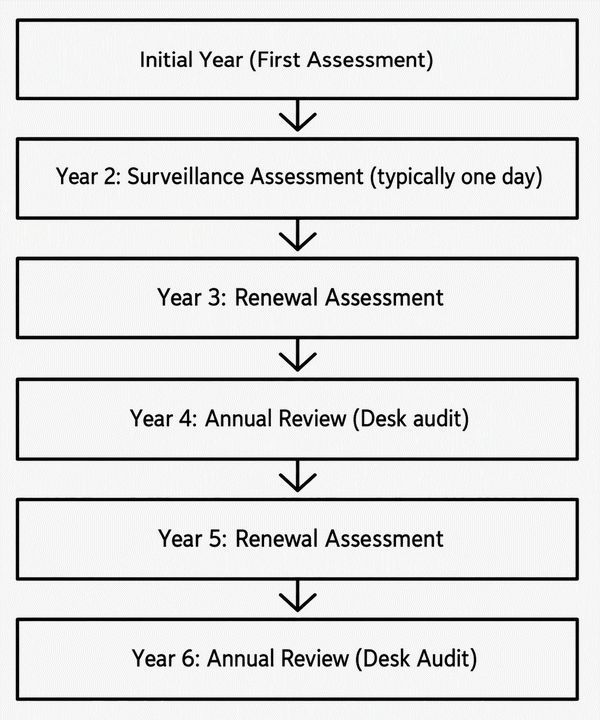
Accreditation is valid for four years, with surveillance assessments during
that period.